A chemical peel isn't just a skin treatment; it's a controlled biological reset that requires as much artistry in the healing as it does in the application. We understand that the idea of the chemical peel recovery process can feel daunting, especially when you're worried about looking "burnt" in public or accidentally using a product that might compromise your results. It's completely natural to feel a bit of hesitation before committing to a procedure that involves visible changes to your complexion, but you shouldn't have to navigate that transition alone or in fear of permanent damage.
This physician-led guide is designed to replace your anxiety with clinical confidence and boutique warmth. We'll walk you through exactly what to expect as your skin revitalizes, ensuring you achieve a clear, natural glow with minimal social downtime. You'll discover which products are truly safe for your healing barrier, how to prevent hyperpigmentation, and how a personalized approach to post-procedure care makes the path to radiant skin both predictable and empowering.
Key Takeaways
- Understand how the depth of your treatment dictates the specific stages of your chemical peel recovery process and the timeline for revealing fresh skin.
- Learn to navigate the first 48 hours of healing, from initial redness to the parchment-like texture that signals your skin is ready to renew.
- Discover why protecting your skin from the Austin heat and UV rays is essential to preventing post-inflammatory hyperpigmentation.
- Identify the difference between normal exfoliation and adverse reactions so you can heal with confidence and clinical peace of mind.
- Explore how a physician-led, customized assessment ensures your results look natural, revitalized, and uniquely yours.
Understanding the Chemical Peel Recovery Timeline
Achieving a revitalized glow starts with the understanding that your skin is a living canvas. The chemical peel recovery process is the biological mechanism where we carefully remove damaged outer layers to reveal the healthy, vibrant cells beneath. This isn't just about shedding skin; it's about stimulating a sophisticated cellular turnover that replaces a dull epidermis with a fresh, resilient surface. By choosing a physician-led environment, you ensure that the acid solution penetrates exactly to the intended depth, maximizing your results while maintaining the highest standards of safety and clinical precision.
Your journey to a natural glow is guided by science and tailored to your specific skin objectives. For those seeking a comprehensive overview of chemical peels, it's helpful to recognize that these treatments work by creating a controlled injury. This process triggers the body’s natural healing response, which is why professional oversight is vital. At 512 Aesthetics, we prioritize an individualized assessment to ensure your recovery aligns with your lifestyle and aesthetic goals, providing a bridge between advanced aesthetic services and boutique-style care.
To better understand this concept, watch this helpful video:
Light vs. Medium Peels: Downtime Differences
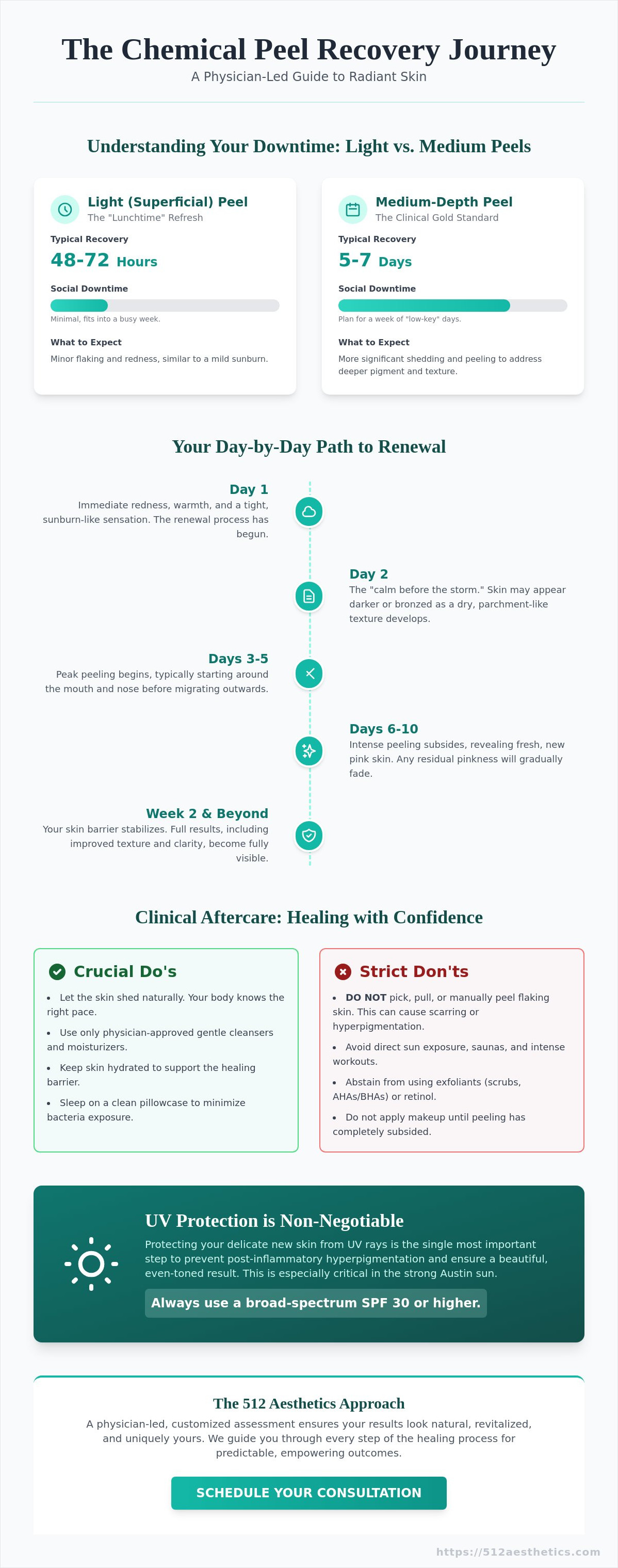
The time you'll spend in the "peeling" phase depends almost entirely on the depth of your treatment. Superficial peels are often called "lunchtime" procedures because the recovery is remarkably swift, typically lasting only 48 to 72 hours. You might experience minor flaking similar to a mild sunburn, making it easy to fit into a busy Austin work week. Medium-depth peels are the clinical gold standard for addressing deeper pigment and texture issues. These require about 5 to 7 days of social downtime. We recommend planning these treatments around your social calendar, ensuring you have a week of "low-key" days before any major events at Zilker Park or downtown gatherings.
The Biology of the "Peel" Phase
During the initial healing stage, your skin undergoes transepidermal water loss (TEWL). This is a temporary state where the skin's moisture barrier is more permeable, leading to that characteristic "tight" or parchment-like feeling. The acid solution works by breaking down the intracellular "glue" that holds dead skin cells together, effectively initiating the shedding process. It's imperative that you don't force this process. Manual peeling or picking at the skin is strictly prohibited, as it can lead to scarring or hyperpigmentation. Letting the skin fall away naturally ensures the delicate new cells underneath remain protected and healthy.
Day-by-Day Recovery: What to Expect After Your Treatment
While the biological foundations are set during your appointment, the visible transformation happens in the days that follow. The chemical peel recovery process follows a predictable, physician-guided path that ensures your skin transitions safely from treatment to a revitalized glow. Understanding this sequence allows you to plan your social calendar with confidence and treat your healing skin with the precision it deserves. Each day brings a new phase of renewal, moving you closer to the clear, luminous complexion you desire.
- Day 1: You'll likely experience immediate redness and a sensation similar to a mild sunburn. The skin feels warm and exceptionally tight.
- Day 2: This is often the "calm before the storm." Your skin may appear temporarily darker or "bronzed" as the treated cells prepare to shed. It often feels like thin parchment.
- Days 3-5: Peak shedding typically occurs now. Peeling usually begins around the mouth and nose before migrating toward the outer edges of the face.
- Days 6-10: The most intense peeling subsides, leaving behind fresh, pink skin. Residual pinkness will gradually fade into your natural, revitalized tone.
- Week 2 and Beyond: Your skin barrier stabilizes. This is when the full results of your treatment, including improved texture and clarity, become fully realized.
The Critical First 48 Hours
The initial window after your treatment is about protection and patience. You must prioritize hygiene by using clean pillowcases and avoiding touching your face. We recommend sleeping on your back with your head slightly elevated to minimize any potential swelling. In-depth clinical information on chemical peels highlights that the inflammatory response in these first two days is a necessary part of the regenerative process. During this time, rely strictly on the gentle, physician-approved topicals provided in your aftercare kit to soothe the initial "sunburn" sensation without disrupting the acid's work.
Navigating the Peak Peeling Days
When the shedding begins in earnest around day three, your primary goal is to resist the urge to pick. Manually removing flakes can cause raw spots, leading to scarring or hyperpigmentation. Instead, focus on intense hydration. Applying a rich, bland moisturizer multiple times a day will keep the peeling skin pliable and comfortable. Most clients find they can return to low-stakes social activities by day six, but if you have a high-profile event, we suggest scheduling your peel at least 10 to 14 days in advance. To ensure your skin is perfectly prepped for this journey, consider scheduling one of our specialized facial treatments to clarify your canvas before your peel. If you're ready to start your own transformation, you can explore our tailored aesthetic treatments today.
Clinical Aftercare: Protecting Your Investment in the Austin Sun
Living in Austin means embracing an active, outdoor lifestyle, but during your chemical peel recovery process, the Texas sun becomes your primary clinical challenge. Your skin is at its most vulnerable immediately after a treatment, as the protective outer layer has been intentionally exfoliated to reveal fresh, delicate cells. This new tissue is exceptionally sensitive to ultraviolet radiation, making rigorous sun protection a non-negotiable part of your aftercare. Without proper shielding, you risk compromising your results with sun damage or unwanted pigment changes.
The intense Austin heat and humidity also play a significant role in how your skin heals. Excessive sweating or exposure to steam can trap heat in the skin, potentially triggering post-inflammatory hyperpigmentation (PIH). We advise avoiding strenuous workouts, saunas, or even long afternoons in the South Austin heat for at least the first 48 to 72 hours. To better understand the potential chemical peel risks and recovery, it's essential to recognize that heat is an inflammatory trigger that can disrupt the calm, predictable healing environment your skin needs.
The 512 Aesthetics Sun Protocol
Protecting your glow in the Hill Country requires more than just a quick application of lotion. We recommend physical sunscreens containing zinc oxide or titanium dioxide over chemical filters, as they sit on top of the skin to reflect UV rays rather than absorbing them. If you're heading out for a walk or a patio lunch, a wide-brimmed hat is a clinical necessity, not just a fashion choice. Reapplication every two hours is vital, especially if you're near water or spending extended time outdoors where the UV index is high.
Safe Skincare Resumption
Patience is your most effective tool when it comes to reintroducing active ingredients. You must pause the use of retinols, AHAs, and BHAs for at least seven to ten days, as these can be too aggressive for a compromised skin barrier. Once the peeling has completely subsided and your skin no longer feels sensitive, you can slowly reintroduce Vitamin C and anti-aging serums to maximize your revitalized results. To ensure your complexion remains balanced and hydrated throughout the year, many clients find that integrating medical-grade facials into their routine provides the perfect maintenance between deeper peel sessions.
Managing Side Effects and Identifying When to Call Your Physician
Your skin's response to a professional treatment is as unique as your complexion. While the chemical peel recovery process is designed to be a predictable transition, it's natural to feel a sense of hyper-vigilance as your skin begins its visible renewal. Distinguishing between the healthy signs of cellular turnover and rare adverse reactions is the foundation of a stress-free healing journey. We view this phase as a collaborative partnership where your observations meet our clinical expertise.
Sometimes, the rapid exfoliation triggered by a peel can lead to what is known as "purging." This occurs when the treatment brings underlying congestion and trapped oils to the surface more quickly than usual. While a few temporary blemishes might feel counterintuitive when you're seeking radiant skin, they are often a sign that the treatment is successfully clearing deep-seated impurities. These breakouts typically resolve quickly as the new skin stabilizes, provided you don't pick or squeeze the area. This physician-led care is essential in preventing post-inflammatory hyperpigmentation (PIH) during these sensitive transitions.
Normal vs. Abnormal Redness
Pinkness is a hallmark of fresh, healthy skin emerging from beneath the old layers. The duration of this flush often depends on your specific skin type according to the Fitzpatrick scale. For those with lighter skin tones, a rosy glow may persist for 7 to 10 days. Those with deeper complexions may notice more of the "bronzing" effect mentioned in previous sections. However, if redness becomes increasingly intense after day three, starts to throb, or spreads to untreated areas like the neck or eyes, it warrants a professional check. Our commitment to evidence-based monitoring ensures that every step of your recovery is handled with the highest safety standards.
Itching and Sensitivity Management
As the skin begins to flake and shed, a mild itching sensation is a common sign of progress. This is the moment where "less is more" becomes your golden rule. You can safely manage this sensitivity by using clean, cold compresses or applying the specific medical-grade balms we provided during your visit. Avoid the temptation to scratch or use abrasive washcloths, as the healing tissue is exceptionally delicate. If you experience extreme swelling, yellow crusting, or persistent pain that feels deeper than a surface-level sting, please reach out to Dr. Jehangir for a follow-up assessment. If you have questions about your specific progress or wish to explore our other aesthetic services, we are here to support your journey. You can schedule your follow-up or next consultation to ensure your results remain on track.
The 512 Aesthetics Approach: Subtle Results Through Guided Healing
A successful chemical peel recovery process culminates in skin that looks revitalized, not just treated. At 512 Aesthetics, our philosophy is rooted in the belief that aesthetic medicine should be a subtle enhancement of your inherent beauty, not a rewrite of it. We move beyond the standard "peeling" phase to focus on the true revitalization of your complexion. By prioritizing evidence-based standards and a physician-led environment, we ensure that your journey from the treatment room to your daily Austin life is smooth, safe, and deeply rewarding.
Every face tells a unique story, which is why a customized assessment is the foundation of every procedure we perform. We don't believe in one-size-fits-all protocols. Instead, Dr. Jehangir and our team evaluate your skin’s specific needs, texture, and goals to select the precise depth and acid profile that will deliver the most natural-looking results. This personalized attention ensures that your chemical peel recovery process is predictable and tailored to your lifestyle, whether you're a busy professional downtown or enjoying the Hill Country weekends.
Your Personalized Skin Journey
Our boutique clinic offers an experience that corporate med spas simply can't replicate. We take the time to understand your long-term aesthetic objectives, often recommending a series of treatments to achieve cumulative benefits. While a single peel provides a beautiful refresh, a hand-selected sequence of sessions can transform your skin's health at a cellular level. This steady, intentional approach respects your skin's biology and your personal decision-making process, fostering a partnership built on trust and expert care.
Next Steps for Your Glow
To achieve a total revitalized look, many of our clients choose to combine their peels with other specialized treatments. Integrating Xeomin can soften fine lines while your skin is renewing, or adding Microneedling can further stimulate collagen production. For those committed to maintaining their radiance year-round, our Elite Membership Club provides a structured path to consistent, evidence-based skin health. We invite you to book a follow-up assessment to ensure your skin is transitioning perfectly and to explore our full suite of Aesthetic Services. Chemical peel recovery is the bridge between clinical intervention and natural revitalization.
Embrace Your Path to Revitalized Skin
Your journey to a luminous complexion is a structured biological transition that deserves clinical precision and boutique care. By understanding the chemical peel recovery process, you move beyond the anxiety of downtime and into a phase of empowered renewal. We've explored how the right healing timeline, diligent sun protection in the Austin heat, and expert-led monitoring work together to reveal your most natural, glowing self.
At 512 Aesthetics, we prioritize evidence-based medical standards to ensure your safety and satisfaction. Under the physician-led guidance of Dr. Saima Jehangir, our boutique Austin practice focuses on achieving subtle, revitalized results that celebrate your unique features. You deserve a healing process that is as predictable as it is transformative. We believe that your skin health is a collaborative partnership, and we're here to guide you through every stage of your renewal.
Ready to begin your transformation? Schedule your personalized skin assessment at 512 Aesthetics today and take the first step toward a healthy, radiant glow. We look forward to helping you reveal your best skin yet.
Frequently Asked Questions
How many days does it take for a chemical peel to stop peeling?
Most visible peeling concludes within seven days for medium-depth treatments, while superficial peels typically finish shedding by day three. Your specific timeline depends on the intensity of the acid used and your skin's natural regenerative rate. Even after the flaking stops, your skin continues to stabilize for another week as the moisture barrier fully recovers.
Can I wear makeup during the chemical peel recovery process?
You should avoid wearing makeup until the peeling phase has completely finished and the skin is no longer sensitive. Applying cosmetics over shedding skin can trap bacteria and lead to irritation or potential infection. Once your skin has fully re-epithelialized, usually around day seven, you can resume your routine with clean brushes and gentle formulas.
Is it normal for my skin to look darker after a chemical peel?
Temporary darkening, often called bronzing, is a standard part of the chemical peel recovery process. This occurs as the treated surface cells dry out and prepare to shed from the face. It's a clinical sign that the treatment is working. This darkened layer will naturally flake away to reveal the fresh, revitalized tissue underneath within a few days.
How can I speed up the healing of my skin after a peel?
You can't rush biology, but you can support it through intense hydration and diligent protection. Use the medical-grade moisturizers provided in your aftercare kit and drink plenty of water to support cellular repair from the inside out. Avoiding sun exposure and heat is also critical, as excess inflammation can slow down the regenerative cycle and compromise your final results.
When can I resume my exercise routine after a chemical peel?
We recommend waiting at least 48 to 72 hours before resuming any strenuous exercise. Sweating and increased body heat can lead to blistering or post-inflammatory hyperpigmentation while the skin is in its initial vulnerable state. For deeper peels, it's best to wait until the most intense peeling has subsided before returning to high-intensity workouts or heated yoga sessions.
What happens if I accidentally pick at my peeling skin?
Picking at shedding skin can lead to raw spots, scarring, or permanent pigment changes. If you accidentally pull a flake before it's ready, immediately apply a thin layer of healing balm and keep the area strictly protected from the sun. The goal is to let the skin fall away naturally to ensure the new cells underneath are fully developed and protected.
Can I get a chemical peel if I have an active acne breakout?
Yes, certain peels are specifically designed to treat active acne by clearing pores and reducing inflammation. We'll perform a personalized assessment to ensure your breakout isn't caused by a condition that might react poorly to the acid solution. We can then tailor the treatment to address both the active blemishes and any resulting texture issues or scarring.
How often should I get a chemical peel to maintain my results?
Maintenance schedules vary, but many clients see the best results with an initial series of three to six treatments spaced about four weeks apart. Once you've achieved your desired outcome, a maintenance peel every three to four months helps sustain your radiant, revitalized glow. We'll help you design a long-term plan that aligns with your specific aesthetic objectives.